


By Li Hou-chen | Edited by Jordyn Haime
Back in June, Taiwanese influencer Holger Chen — also known by the moniker “the gym director” (館長), or guanzhang — ignited a firestorm back home as he was traveling in Shanghai. The controversy centered on a seemingly simple question Chen was asked during a livestream that caused him to falter: What country is he from?
Through the rest of his China tour, and long after his return to Taipei, Chen faced the fury of audiences back home who found it morally reprehensible, and politically suspect, that he had not simply been able to answer: “Taiwan.”
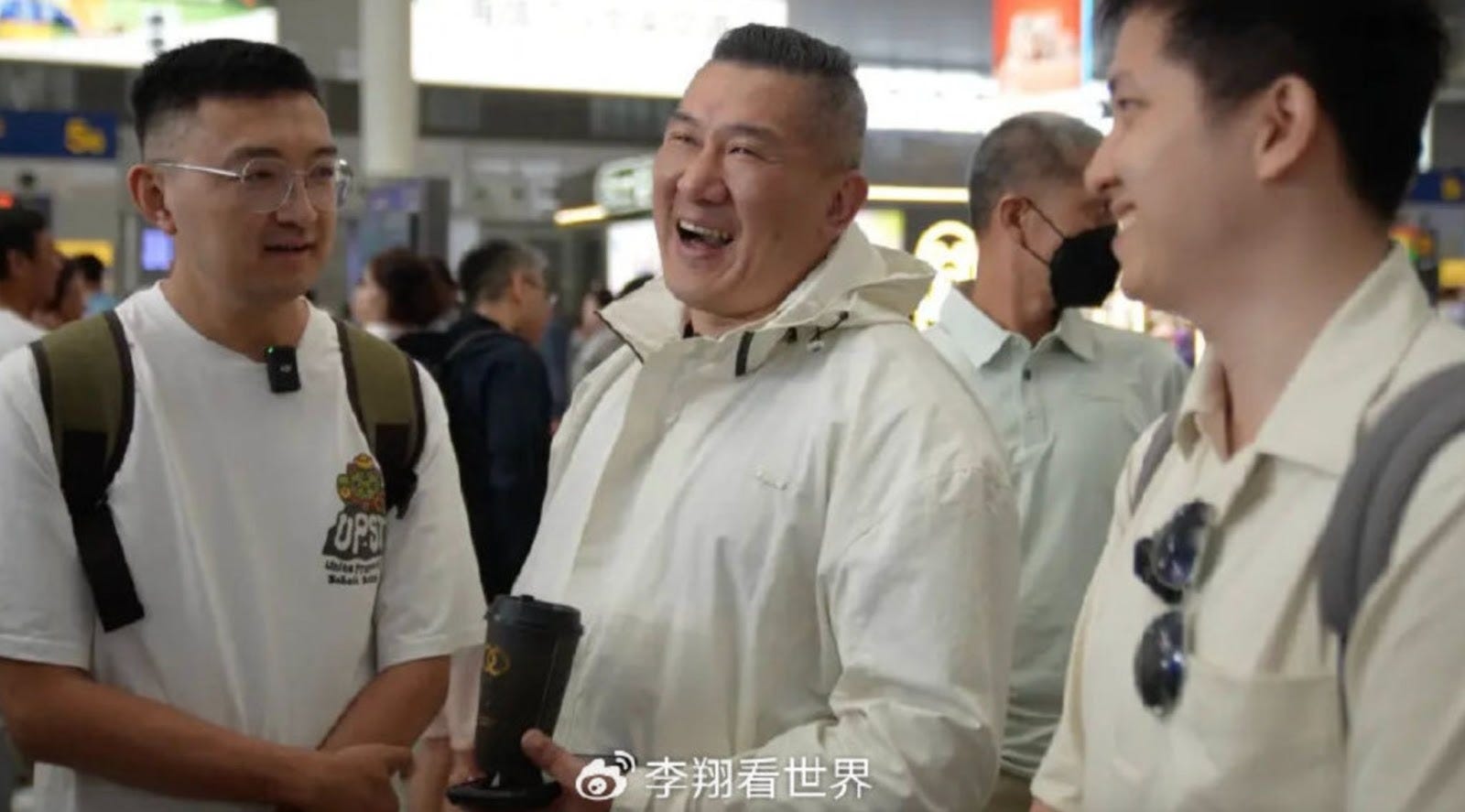
Chen has repeatedly insisted that his trip to China was a spontaneous personal choice and did not involve cooperation with government departments or state-linked institutions. Some of the details of his travels seem to corroborate this claim. While filming at the airport upon his arrival, for example, he was stopped — suggesting local authorities had not been briefed to give him the green light. And multiple times during his trip, the influencer had to apply for filming permits.
But suspicions have persisted in Taiwan, where questions about the nature of Chen’s promotional tour intersect with much deeper and existential concerns about national sovereignty. As Chen returned to Taiwan, he was met at the airport by Taiwanese influencer Lee Yi-hsiu (李易修) — known online as “History Bro” (歷史哥) — who made a point of emphasizing in one of his videos that Chen’s entire trip was organized and handled “by his mainland influencer friend Wang Xiao.” “There was no involvement by mainland officials at all,” Lee stressed, adding in reference to Taiwan’s ruling Democratic Progressive Party: “We hope the DPP stops spreading false accusations.”
Efforts at reassurance aside, clarifying the nature of Chen’s trip is crucial. If the influencer was truly traveling for personal leisure, then his actions fall within the scope of individual freedom of speech — and anything he posted online should be protected according to his rights under Taiwan’s Constitution. If, however, Chen’s trip was not spontaneous, but rather was an influence operation prearranged by official Chinese actors — an external political strategy employed by the Chinese Communist Party (CCP) that is generally known as a united front operation — then the story is far more complicated. Chen’s actions could raise the question of whether he was acting as a foreign agent, raising potential legal issues.
Was Holger Chen’s June trip to Shanghai a united front operation? We can begin to answer this question by first examining the key figures associated with Chen’s tour.
The Handlers
Four individuals in particular are of interest. These include Lee Yi-hsiu (李易修), the Taiwanese influencer who met Chen at the airport upon his return, and three Chinese influencers — Wang Xiao (王驍), Li Xiang (李翔), and Yang Sheng (楊升) — who accompanied Chen at different points during his China tour. While each had appeared in Chen’s livestreams before, their connections with one another run far deeper.
Yang Sheng is a chief reporter for the English-language edition of the Global Times (環球時報), the nationalist international-facing newspaper under the management of the CCP’s official mouthpiece, the People’s Daily. His most recent bylined report appeared in February this year, making his role with the state media outlet current, not historical.
Yang has direct relationships with the other two influencers, Wang and Li Xiang. He and Li host a regular program on the Chinese video platform Bilibili called “Break Talks” (破圈), which back in June ran several responses to Holger Chen’s trip. These included a video released while Chen was still in Shanghai called “Connecting with History Bro: I Will Use My Whole Life to Fight Taiwan’s ‘Poisonous Independence’ Curriculum!” Six days later, he and Li released another video called “North-North Dialogue: Why We Reached Out to Guanzhang.”
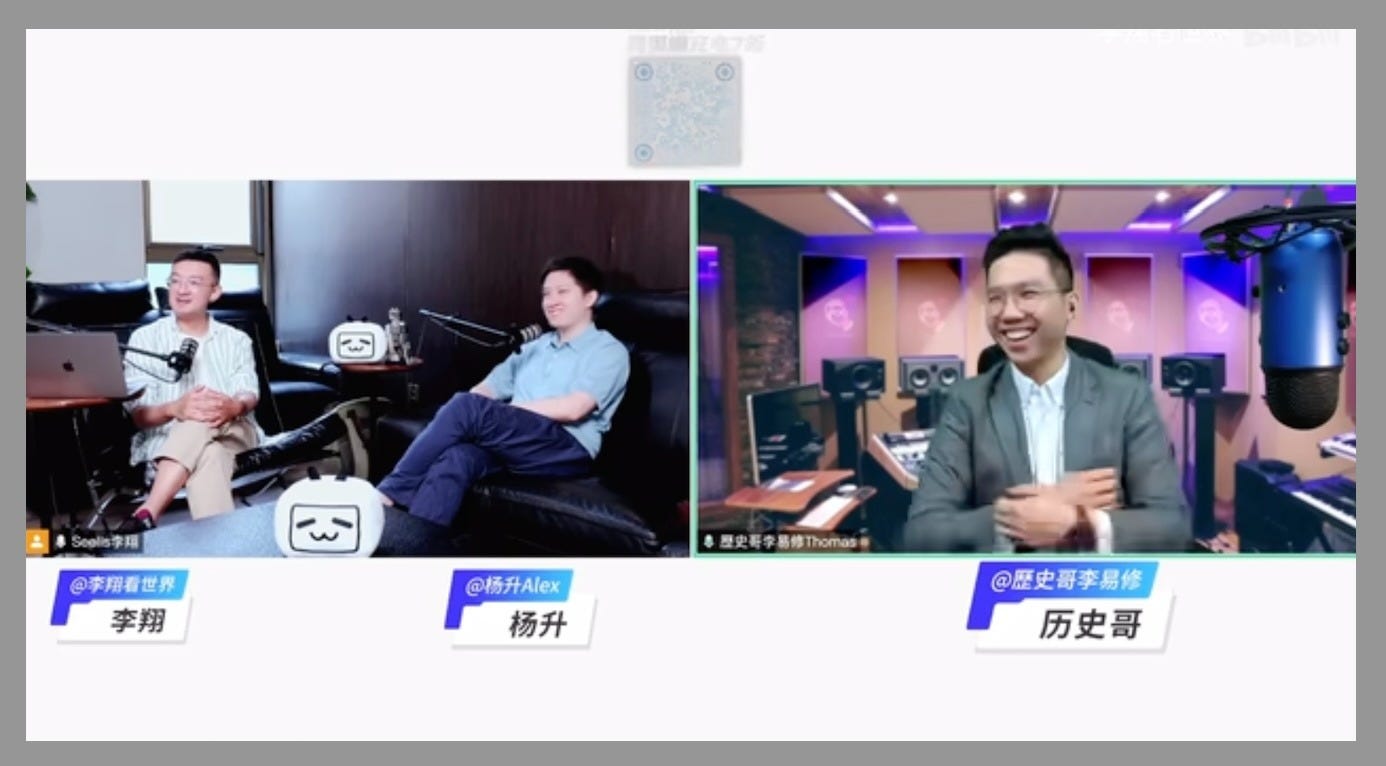
In one program in early July whose title — “How to Seize the Heights of Public Opinion in the New Era” — was replete with official terminology, Yang and Li clearly stated that their mission is to bring Taiwanese influencers onto Chinese media platforms to “dance together” (共舞). “Break Talks” invites questions not just about united front work toward Taiwan, but also toward Hong Kong. On July 1, corresponding with Hong Kong’s Establishment Day commemorating the transfer of sovereignty from the United Kingdom to China, the program interviewed pro-Beijing legislator Chan Chi-ho (陳志豪) for a segment called “Let Faith Spread Across the Motherland.”
According to his personal LinkedIn page, Yang’s livestreaming partner, Li Xiang, is originally from Kunming, the capital of China’s southwestern Yunnan province. From 2010 to 2011, while still an undergraduate, he took part in a one-year academic exchange in Taiwan. After a stint at state-run provincial media in Yunnan, Li moved on to Beijing, where he worked for several media and technology companies, including the government-run publisher China Publishing Group Corp. and the digital security firm Qihoo 360. He later started his own video channel on Bilibili, a self-media (自媒體) brand called “Reporter Circle” (愛牠記者圈). This was the predecessor of “Break Talks,” which has made issues related to Taiwan “unification” its singular focus.
Yang and Li clearly stated that their mission is to bring Taiwanese influencers onto Chinese media platforms to “dance together” (共舞).
In one of the more outstanding examples of the form at “Break Talks,” a January 2024 episode featured a discussion between Li Xiang, Yang Sheng, and Wang Xiao about how China should best govern Taiwan.

Even as Li Xiang’s self-media career flourished, he began taking on official roles that seemed to deepen his association with the CCP’s broad influence network under the United Front Work Department (UFWD). In January this year, a report by the official China News Service (CNS) — itself directed by the UFWD — detailed a gathering of social media influencers in Beijing that was co-organized by the local UFWD office in Chaoyang District alongside the Cyberspace Administration of China (CAC), the country’s top internet control body, and Li’s media production brand “Views” (世界觀). As the report mentioned Li’s involvement, he was introduced not just as a podcast host for “Reporter Circle,” but as a member of the New Social Strata Association (新的社會階層人士聯誼會) of the capital’s Chaoyang District, which operates directly under the district-level UFWD.
Closely associated with the united front strategy, the term “new social strata personnel” (新的社會階層人士) refers to intellectuals outside the Party who work through these associations to deepen relations between the public and the government. Associations of this kind have cropped up throughout China’s united front bureaucracy in recent years. The core mission of the above-mentioned meeting of social media influencers in Beijing, spelled out clearly in a related release from the district UFWD, was to carry out “cyber united front work” (網絡統戰工作) — referring to the systematic cultivation and mobilization of influential internet personalities (”verified accounts” or “big Vs”) to advance CCP political objectives through online platforms. Li Xiang has worked closely with the district UFWD on numerous initiatives of this kind.
But of the three China-based influencers accompanying Holger Chen on this China trip, the most high-profile of all is Wang Xiao. On Bilibili, Wang has 2.37 million followers compared to Li Xiang’s 100,000 or so. Yang Sheng has even fewer.
How has Wang Xiao made a name for himself? Since 2018, Wang has hosted “Xiao’s Take” (驍話一下) a program streamed on Bilibili by the Observer (觀察者網), a popular Shanghai-based news site. “Xiao’s Take” emerged just as the trade war was raging between China and the United States, and as China’s Ministry of Foreign Affairs was taking a more aggressive approach online — referred to as “wolf warrior diplomacy.” With its distinctly anti-American tone, Wang’s program rose rapidly in popularity and became especially influential among young Chinese.
Wang eventually left the Observer to strike out on his own. He steadily built a reputation among Chinese youth as an expert on American and international affairs. In 2023, he achieved further government recognition as he was given a Number Ten ranking on a roster of “Good Chinese Youth Netizens” announced by several offices and organizations, including the Chinese Communist Youth League and the Cyberspace Administration of China. Wang’s endorsement as a state-approved “Good Netizen” (好網民) marked him as possibly not just an influencer but a system insider.

The “Good Netizen” honor is, of course, not iron-clad proof that Wang holds an official title. But at this point, it is helpful also to turn our attention to another important player behind all three of these figures — Wang’s former employer, the Observer. The Shanghai-based outlet, in fact, casts a long shadow across the Holger Chen incident.
A Special Relationship
Why is the Observer important to this investigation?
On June 27, shortly after his return to Taiwan, Chen accepted an invitation from the Observer to discuss his China trip in a joint livestream alongside a political heavyweight, Victor Gao (高志凱), a Chinese lawyer and businessman who among his many colorful associations (he was a translator for Deng Xiaoping in the 1980s) is vice president of the Center for China and Globalization (CCG) — a Beijing-based think tank that has faced repeated accusations for its alleged ties to the united front system, but has claimed independence. Gao gained international visibility last year when he discussed (as many within the system would not) the disappearance of the former minister of foreign affairs Qin Gang (秦刚) during an interview with Al Jazeera.
Through his connection with the Observer, Holger Chen had already rubbed shoulders with a number of important figures within China’s foreign policy establishment. There was Wang Xiao, of course, the young political commentator who had begun his career with the Observer. And there was Yang Sheng, the Global Times chief reporter, who moonlighted as an Observer columnist as well as a regular guest on “Sideline Commentary” (觀棋有語), the platform’s military program. Li Xiang’s “Break Talks” program regularly hosted political heavyweights with close ties to the Observer. They included international affairs scholar and commentator Jin Canrong (金燦榮) of Renmin University, and even the far-right Russian political philosopher Aleksandr Dugin, who has been called “Putin’s brain.”
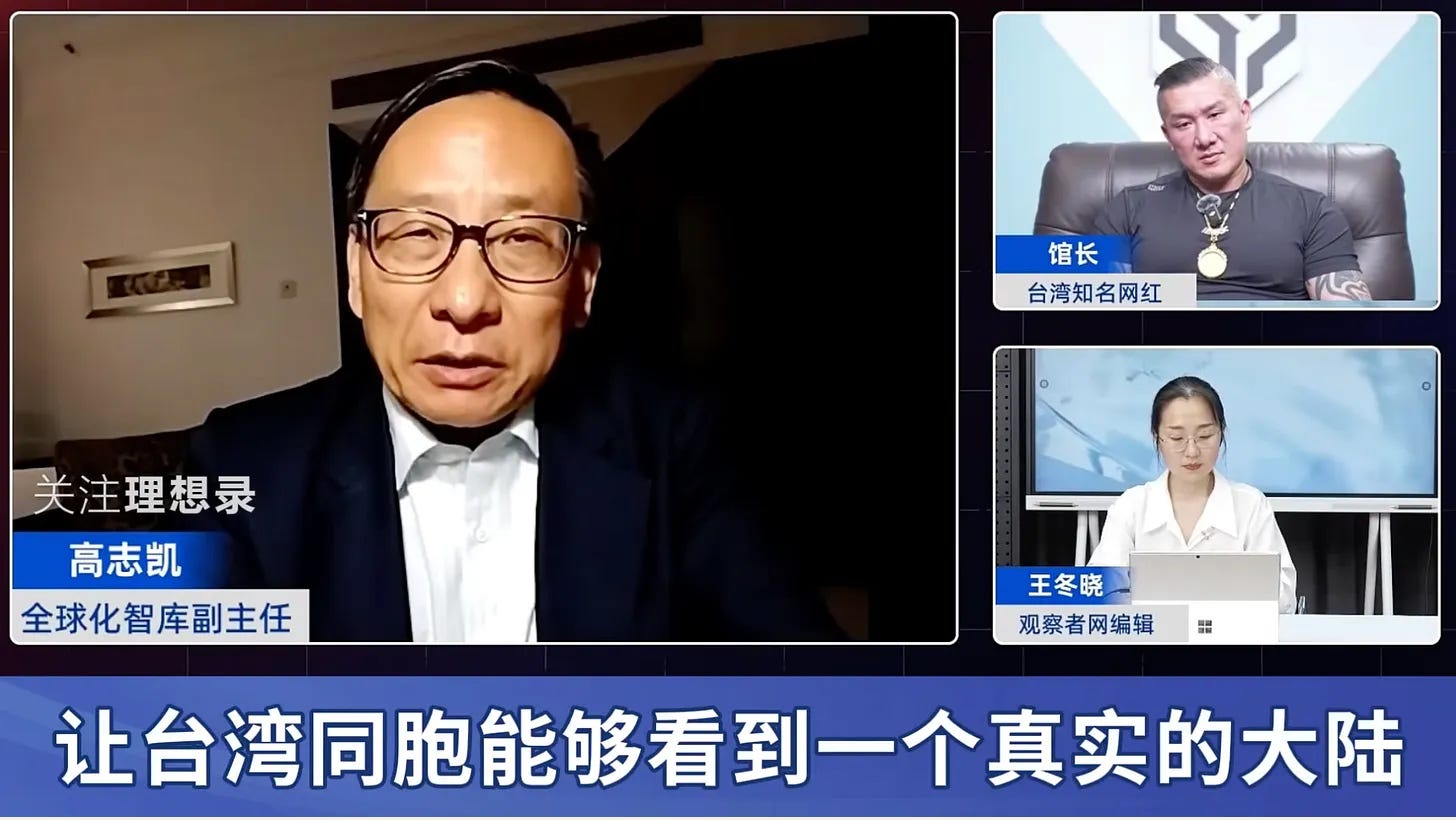
For a country as vast and populous as China, this circle of “non-party intellectuals” is exceptionally narrow. It is all the more exceptional for its interlacing connections. Draw a line between any two or three of these individuals — Lee Yi-hsiu, Wang Xiao, Li Xiang, Yang Sheng, Victor Gao, Jin Canrong — and they will all have collaborated at some point.
This Observer-Fudan University circle lies at the core of China’s state-run public opinion operations online.
The special relationship between the Observer and the China Institute at Fudan University merits its own investigation. For our purposes here, we will just note that these two Shanghai-based organizations have closely overlapping connections through their respective representatives. One is China’s most influential pro-establishment media outlet, the other an official academic institution and think tank. Together they have formed an expansive network covering topics such as theory building, policy advocacy, public opinion warfare, and united front operations, serving as an engine of China’s online information war and united front work.
For a country as vast and populous as China, this circle of “non-party intellectuals” is exceptionally narrow. It is all the more exceptional for its interlacing connections.
Chen’s connections with Wang Xiao, Li Xiang, and Yang Sheng during his trip, as well as his later online meeting with Gao — all members of this network — suggest that Chen’s decision to travel to China was not spontaneous or independent. At the same time, it was not simply conceived as a single effort executed through a branch of the United Front Work Department. Instead, Chen had been drawn, as a Taiwanese key opinion leader (KOL), into China’s massive network of public opinion warfare and online united front work, of which the Observer-Fudan is a key component. As a result, Chen had become a cog in this seamless apparatus of cyber warfare.
Fuel for the Public Opinion War
Once we have this context, many mysteries can be unraveled.
First, Chen’s private itinerary throughout the trip involved continuous applications and approvals, giving the appearance of spontaneity. How authentic is this? Let’s take a look at the three people who assisted him with approvals during his travels: Wang Xiao, Li Xiang, and Yang Sheng.
Given the backgrounds of these individuals and their close relationships with various party-state entities, we must seriously consider the possibility that this was in fact a simulated “approval process” mimicking the experience of an ordinary traveler.
The same process explains why the authorities would allow Chen to livestream from China, to audiences outside the country, without fear of serious violations. The risks were mitigated for a very straightforward reason: The main portions of Chen’s livestreams — his words and actions — were all framed by the active involvement and presence of Wang, Li, and Yang. We might even say that he was “supervised” by these key figures.
Chen, therefore, can be viewed as a strictly controlled variable. He was actively controlled by the aforementioned “non-party intellectuals.”
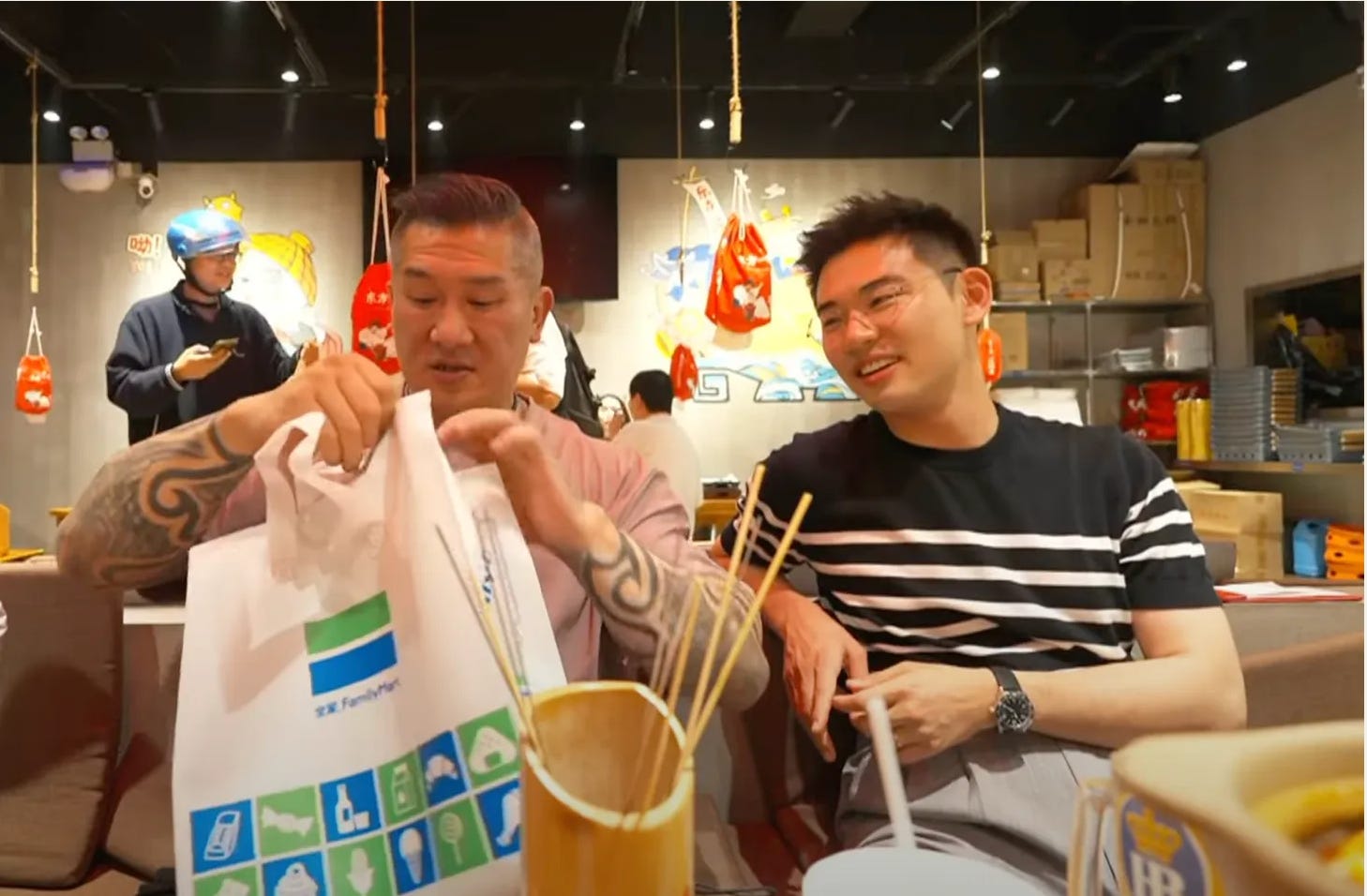
Wang Xiao “supervised” Chen when he first arrived in China. On the first leg of the trip, after Chen arrived in Shanghai on June 10, Wang appeared in the initial “barbecue and beer” livestream; the next afternoon, on Nanjing Road Pedestrian Street, Wang remained at Chen’s side.
Nearly the entire Hangzhou itinerary was “supervised” by Li Xiang and Yang Sheng. Their presence ensured both the political correctness of the content and that dialogue in the videos met current political messaging needs. Chen’s livestreams were also broadcast outside China’s firewall, meaning that regardless of any disputes or “politically incorrect” incidents that might be triggered, the controlled internet environment within the firewall could ensure such controversies wouldn’t spill over into the domestic sphere and create problems at home.
But why was it so important to plan such livestreams? This question can best be answered through the lens of information warfare and the goals of the united front system.
As an engine of public opinion manufacture and manipulation, the operating logic of the united front mechanism is core. In fact, Chen’s China trip was required only as a source of raw material. This raw material could then feed a secondary process of content production that could be used to amplify state talking points on issues like Taiwan.
At least 18 secondary videos related to Chen’s trip, posted by his fans to Bilibili shortly after, received more than 500,000 views. One of these videos, discussing the value of the united front approach, drew more than one million views. This number does not even account for the views gained by other content creators who responded to the event — such as Lee Yi-hsiu (“History Bro”), who claimed after Chen’s broadcasts to have made the initial introductions that made the entire event possible. Lee has subsequently facilitated regular “Cross-Strait Dialogue Island-to-Island Livestreams” with “Good Netizen” Wang Xiao.
“Break Talks” has also since released interviews with Lee Yi-hsiu, programs featuring Jin Canrong advocating for unification by force, as well as on “occupying the heights of public opinion in a new era.” This activity triggered a peak in the discussion of Taiwan and military unification in China. What is influential in China domestically is not Chen’s livestream content, but rather the subsequent, repackaged content derived from it. Without a major event like Chen’s China trip, these later discussions would lack an anchor.
The final question is one that has puzzled many observers of these events: Chen is someone who once identified as “anti-communist,” supported Taiwan’s Democratic Progressive Party (DPP), and directly criticized Xi Jinping. So why would China be so welcoming to Chen and his livestreams?
In fact, Chen’s China trip was required only as a source of raw material. This raw material could then feed a secondary process of content production that could be used to amplify state talking points on issues like Taiwan.
In all likelihood, this was a simple calculation of impact for decision-makers within the united front system. Among the Taiwanese influencers on YouTube with over one million followers, few actively engage in politics. The field narrows considerably too when you look for influencers who are more skeptical of the so-called pan-green camp — those tending to align with the DPP. Chen might, in fact, be the only viable candidate.
Given these conditions, Chen was a logical choice for cooperation if the goal was to reach a wider audience. Generally speaking, the purpose of united front activities is to target those outside the CCP-led system. Chen’s past “anti-communist” stance was more opportunistic than substantive, and he has no history of involvement in local politics in Taiwan. All of this makes him a natural target.
China’s expansive united front system has long regarded the question of Taiwan sovereignty to be a core issue, and so it is a priority in the full-fledged effort to manipulate public opinion. Controversy is needed to draw attention and ignite emotions — and that is precisely the role Chen’s visit played.
A Template for Influencer “China Trips”
Chen’s fully livestreamed China trip is far from unique. Back in March this year, YouTube influencer iShowSpeed (Darren Watkins) made a high-profile visit to China that was also fully livestreamed. With his energetic personality, and more than 15 million subscribers on YouTube, iShowSpeed was able to trigger a massive wave of public discourse in China, pushed along by state-run media. This came months ahead of Holger Chen’s visit.
Not surprisingly, iShowSpeed’s itinerary was carefully planned by multi-channel network (MCN) companies — third-party providers that partner with content providers — with full participation by local tourism and transportation departments. Far from spontaneous, this campaign was orchestrated just as China was pushing tourism-related propaganda and trying to drive growth in the sagging sector.
Like Chen’s trip months later, iShowSpeed’s tour triggered a massive wave of secondary content creation, with his praise and approval of China driving another surge in enthusiasm across both state media and social media.
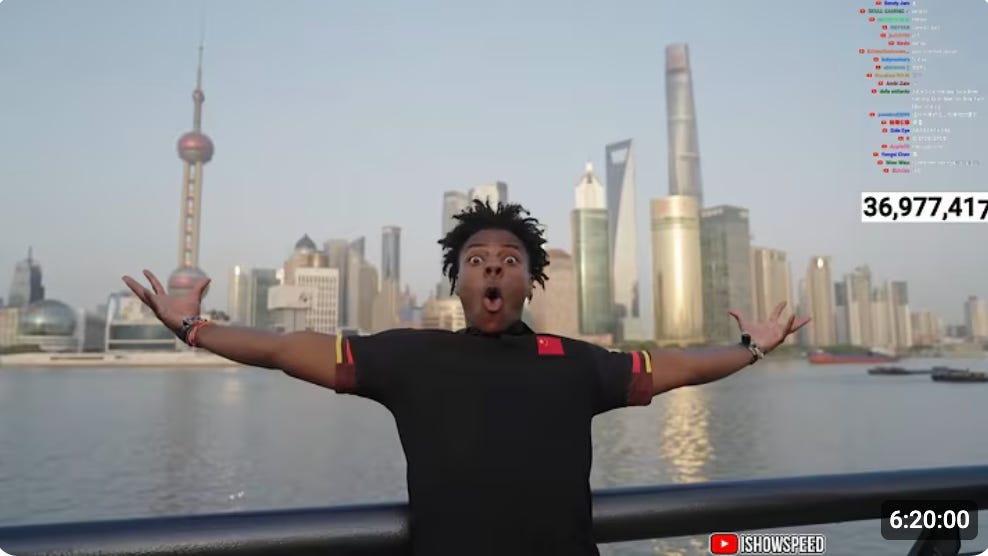
iShowSpeed’s China trip established a specific kind of “template” for campaigns to follow. For example, the livestream needed a second character besides the protagonist. For iShowSpeed’s trip, this role was played by his bodyguard; for Chen’s trip, the interaction came from reporters tailing him and covering every moment of his itinerary. Of course, there were some moments during iShowSpeed’s trip that drew controversy, including instances of racism. But these proved insignificant compared to the vast internal and external propaganda benefits. The success of the iShowSpeed tour laid the groundwork for a new livestream model for foreign influencers.
The same day Chen arrived in China, Bloomberg published a report about recruitment advertisements from official media like China Youth Daily boasting free tours to China and a “China-world youth influence exchange,” recruiting young foreign social media influencers with at least 300,000 followers to collaborate with Chinese content creators.
Inviting foreign influencers to travel in China on promotional or united front itineraries, and collaborating with Chinese content creators in the process, has long been a standard official tactic. While in the past these tours were most often organized by local tourism or united front departments, they have now become a more comprehensive national strategy.
This is the lesson to draw from Holger Chen’s trip to China. Far from an isolated phenomenon, it represents part of an influence strategy now being systematized by media and propaganda authorities nationwide — one that necessitates a comprehensive, strategic response rather than piecemeal, case-by-case reactions.
Li Hou-chen is a Chinese independent intellectual living in Japan. He is the host of the newsletter, podcast, and YouTube channel “Fear Nation,” and one of the hosts of the YouTube program “The Three Aquateers.”
I also worked for Guancha before. As a person who knows both Wang Xiao and Yang Sheng pretty well, I’m pretty sure Wang didn’t need any “permission“ to meet an influencer. Another factual error here is that Yang has left the Global Times for a while, and he doesn’t work for official media. It’s problematic to see that Chinese influencers are often presumed to be puppets lacking a will of their own, as if manipulated by the invisible hand of "government plot." They are depicted as having no views or voice of their own, just executors of orders.
I read with great interest and curiosity. It's a well-researched piece, backed by solid evidence, and does a commendable job highlighting potential digital influence tactics in cross-strait relations.
However, it has limitations. The article displays a critical bias toward Beijing, consistent with the publication's focus and the authors' Taiwan-sympathetic backgrounds. This leads to selective sourcing in heavily relying on anti-CCP reports and green Taiwanese media; while giving less attention to neutral or pro-Beijing views that might see these interactions as genuine cultural or business exchanges.
Additionally, the Chinese influencers are portrayed with limited agency, often framed as mere tools of a CCP rather than individuals with personal or commercial motivations, which oversimplifies their roles in China's hybrid media landscape.
Cross-strait visits and collaborations are commonplace and often driven by legitimate economic interests such as trade, partnerships, and tourism remain strong despite political tensions. Not every exchange is politically orchestrated; many are spontaneous or profit-oriented.
While state amplification maybe evident in cases like Holger Chen's, applying a united front label to all such trips risks overgeneralization and unfairly casting suspicion on benign interactions.
Overall, it's a thought-provoking article that rightly calls for vigilance, but it would benefit from greater balance to fully capture the human and economic dimensions of cross-strait ties.